





Agile
11 minutes reading time


See exactly how AI impacts your team's performance.

AI decision partner helping engineering leaders with actionable insights.

Real-time tracking and insights into DORA metrics.

Detailed visual maps of your entire software development process.

Help development teams monitor and benchmark their productivity.

Improve your software engineering with accurate metrics tracking.

Set inspiring objectives and track their progress.
Agile process improvement changes how you work by helping you and your team achieve better results with less frustration. It’s not about overhauling everything at once but making steady, meaningful changes that bring out your team’s potential. Whether refining workflows or tackling inefficiencies, the key is to focus on what matters most to your goals and customers.
You already know the challenges: delayed timelines, missed expectations, and inefficient processes that hold your team back. Minor, focused adjustments can have a significant impact here. Leveraging improvement opportunities allows you to create an environment where teams collaborate better, deliver faster, and effortlessly adapt to change.
At Axify, we’re here to guide your improvement efforts with tools and insights that help you take the right steps at the right time. Here, we'll teach you what agile process improvement is, how to implement it, and much more. Let's get started.
Agile process improvement focuses on integrating continuous improvement into Agile methodologies. It helps you refine workflows, address inefficiencies, and adapt processes to achieve better outcomes, faster.
Incorporating small, iterative improvements allows your Agile teams to work smarter, adapt to changes seamlessly, and consistently deliver value. This approach balances speed and quality, boosts team productivity by 60%, and enhances customer satisfaction.
Unlike traditional methods, Agile process improvement focuses on continuous improvement efforts throughout the development cycle. Regular retrospectives, real-time insights, and actionable feedback from team members are critical.
Whether you're improving sprint cycles or collaboration within cross-functional teams, this process helps you stay aligned with Agile principles while reducing wasted time and effort.
Agile process improvement is essential for achieving faster delivery, better products, and happier customers. Focusing on fixing problems and building a process that continuously adapts to needs is critical.
Here’s why you need Agile process improvement:
The point is to be more responsive to changes and deliver better quality to customers. This leads to customer satisfaction, loyalty, and higher ROI.
Well-implemented Agile process improvements ensure you meet goals and exceed expectations by adapting to challenges and opportunities in real-time.
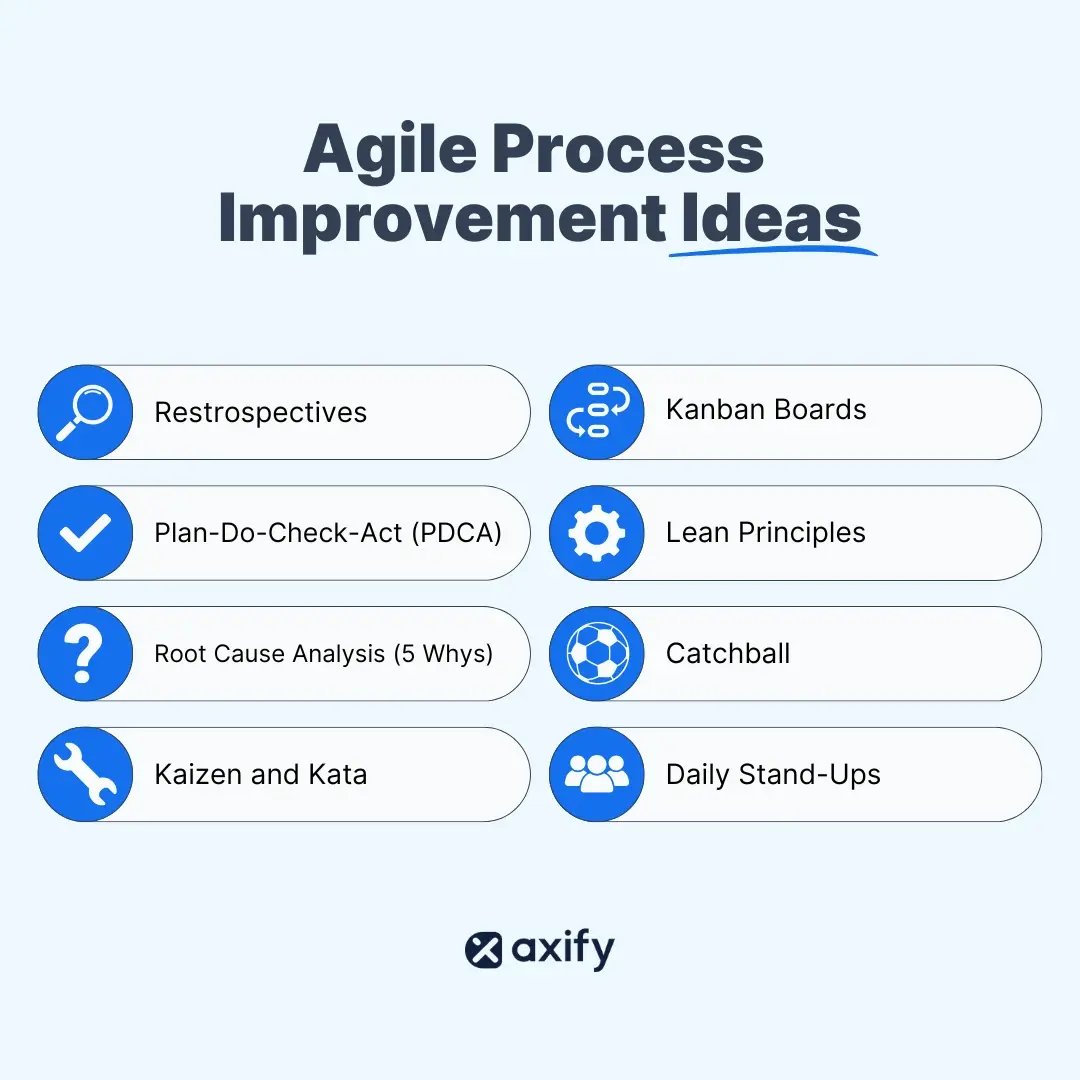
Improving your Agile processes requires more than following standard frameworks. You should also explore ideas that refine workflows and help your team perform better.
Whether fine-tuning daily tasks or tackling serious challenges, the tried-and-tested approaches below offer practical ways to bring positive change to your team.
Retrospectives are at the heart of continuous improvement. These team reviews allow you to reflect on what worked, what didn’t, and what can be improved. Regular retrospective meetings allow your team to address challenges and celebrate successes.
This keeps conversations flowing and makes improvement a continuous part of your Agile practices. Regular retrospectives build trust, boost team morale, and help foster a culture of collaboration.
The data is on our side. According to a survey conducted by the Agile Alliance, 92% of respondents reported that Agile retrospectives positively impacted their team's performance.
The PDCA cycle is a practical framework for driving iterative improvements. You can start by identifying areas for improvement and then test changes on a small scale. Once you evaluate the results, you should implement successful ideas more broadly.
This cycle is perfect for proof-of-concept (POC) experiments. For example, your team could test a new feature using feature flagging to gather real-time feedback before rolling it out. This method reduces risk and helps refine your approach during the planning stage.
PDCA ensures your improvement initiatives remain manageable and impactful. It’s a reliable way to test and implement ideas without overwhelming your project team.
When problems arise, it’s tempting to fix symptoms rather than address the real issue. Root Cause Analysis, especially the "5 Whys" technique, helps you dig deeper. Repeatedly asking “Why?” enables you to uncover the true source of your problems.
For example, if delays occur in a development cycle, asking “Why?” five times might reveal that unclear requirements were the root cause.
Once you understand the source, you can implement changes to prevent the issue from recurring. Thus, Root Cause Analysis keeps your improvement efforts focused and effective.
Kaizen and Kata are essential tools for incremental and dynamic improvements.
Kaizen focuses on small, continuous changes inspired by 10 key improvement principles. This approach keeps your team focused on improving processes over time without the need for massive overhauls.
Kata takes a more structured approach by helping you solve dynamic problems step by step. You can track Kata improvements using tools like Kanban boards, which provide real-time insights into cycle times and workflows. We’ll discuss them in a second.
The point is that both Kaizen and Kata encourage a continuous improvement mindset while aligning with your Agile approach.
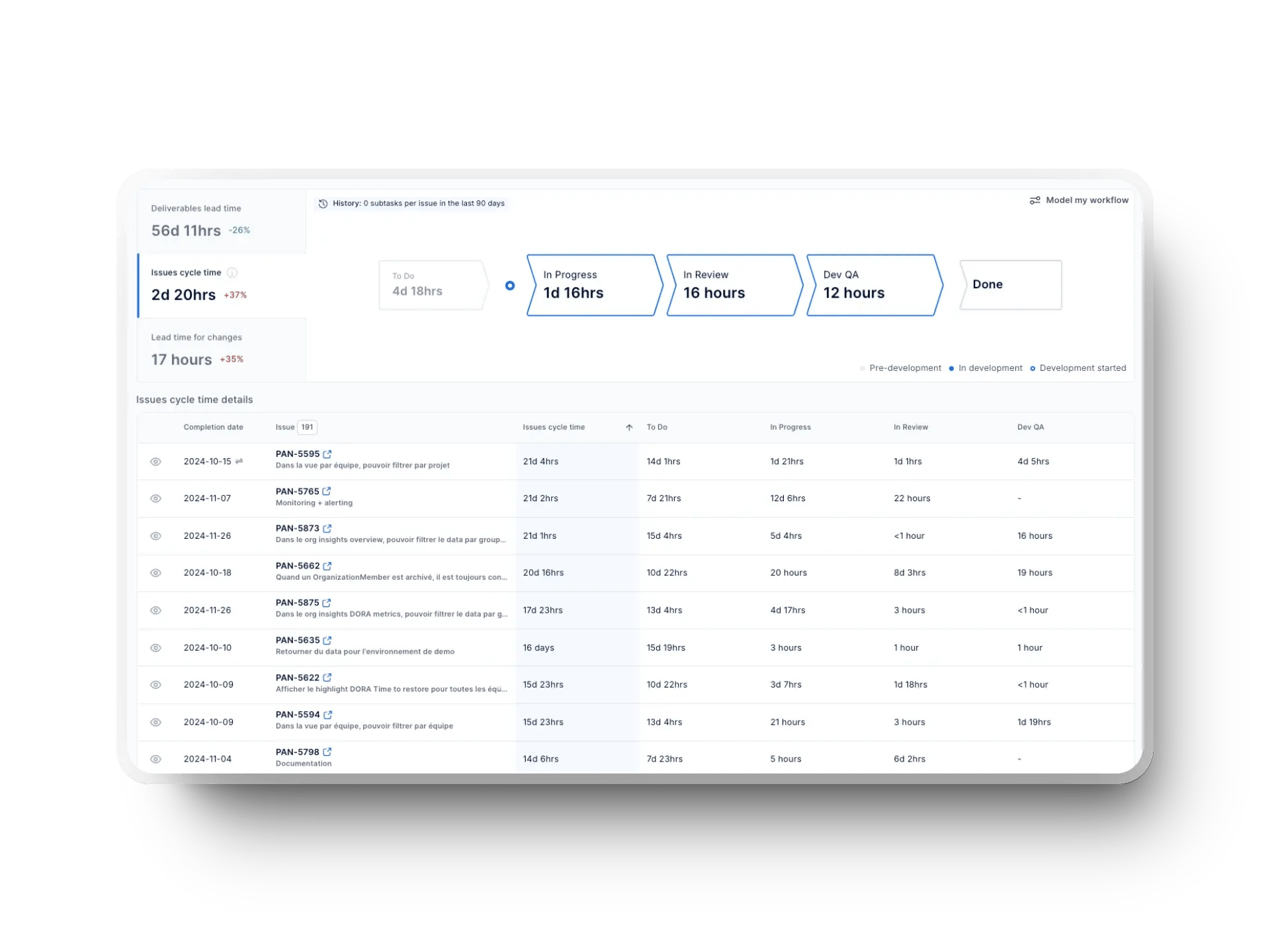
Kanban boards are an excellent tool for visualizing workflows and keeping your team on track. Mapping out every step in your process allows you to balance workloads, identify bottlenecks, and keep things running smoothly. Whether monitoring tasks in progress or prioritizing what’s next, Kanban gives you a clear picture of your team’s efforts.
When analyzing team efforts, consider metrics like lead time, cycle time, and throughput. Following these metrics in Axify will give you real-time insights into how efficiently your team operates. You’ll spot areas for improvement and adjust quickly so that your tasks move seamlessly from start to finish.
Organizations that implemented Kanban tools to track metrics such as lead time and throughput experienced a 45% increase in productivity and a 30% decrease in delivery time.